
FBKTIM: Gait as Template
FBKTIM: Gait as Template
1 hour 30 minutes
The instructors
Overview
From Bodily Knowledge to Intuitive Movement (FBKTIM) is a seven-part live series with physical and yoga therapist Sherry Brourman, built chapter by chapter from her book of the same name. Each session unpacks one chapter, bridging physical therapy, yoga therapy, and pain science into a framework you can bring straight into your own practice, with research assistant Gina moderating.
This session covers Chapter 4: Gait as Template. New to the series? Start with the free introductory session to see how it all connects, or see the full series and register here.
It is highly recommended that you have a copy of the book to accompany this series. You can purchase a copy of the book from Amazon or Singing Dragon, and you can learn more about the book on Sherry's website.
About Chapter 4: Gait as Template
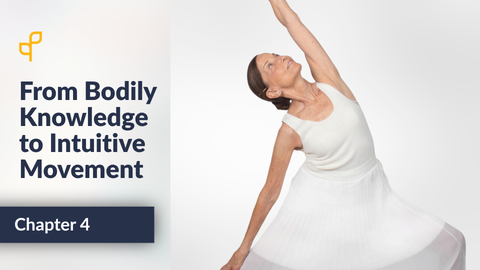
Chapter 4 introduces the concept of template thinking by exploring the biomechanical and whole-person similarities between walking and yoga. Gait, our first athletic endeavor and the movement we have practiced the most, provides a particularly useful template for understanding our personal movement systems and our yoga posture practice. Beginning as babies, we develop our earliest movement patterns and gradually layer onto them the physical, emotional, and spiritual histories that contribute to the recognizable movement styles we carry with us.
Like the precision that allows us to recognize individual faces, even though each has two eyes, a nose, and a mouth, our individual movement styles are recognizable across the many movements we make. The same patterns we see in gait reappear on the yoga mat, and what we see on the mat reappears when we reach up to put the dishes away. All Triangle Postures are recognizable as Triangle, yet each is unique to the person doing it.
By exploring the similarities between walking and yoga, we find further evidence that movement patterns are never purely physical, but rather reflections of each whole person. As we recognize our patterns and habits across different movements, we can increasingly trust what we feel and see, distinguish habit from intention, and give ourselves a reason to change what no longer serves us. In doing so, we develop greater choice in creating comfortable sensations, ease of breathing, and movement that comes increasingly from the inside out.
Learning Objectives
By the end of this chapter, participants will be able to:
- Recognize how individual movement patterns and habits are reflected across gait and yoga postures, using these similarities to develop template thinking.
- Recognize how movement style is personality-driven and remains identifiable throughout life, even as specific movement patterns and habits change through deliberate attention and practice.
- Utilize gait as a template and tutor for observing, understanding, and exploring yoga postures.
- Understand the phases of gait and recognize how they relate to transitions within yoga posture practice.
- Differentiate relatively anterior-weighted from relatively posterior-weighted gait and recognize how the same weighting patterns as those seen in gait also occur in yoga postures.
- Experience mid-stance as a recurring opportunity to feel and utilize Energetic Symmetry, and apply that experience to yoga postures and ultimately to movement in daily life.
- Understand the progression and integration of the gait elements as they develop within every step from the feet to the head.
- Apply gait elements to any chosen yoga posture to see, feel, and sense those same elements within the posture.
Audience
Details and What's Included
The registration fees are as follows (all in CAD):
- Regular Registration: $495
- Early-Bird Registration: $405 (ends October 3, 2026)
- Embodia Member Registration: $455 (after early-bird registration ends)
- Student/New Grad Registration: $395 (graduation date of January 2024 or later)
Related links:
- Embodia Memberships
- Add CEUs to my course certificates
- Add graduation proof to access the student/new grad pricing
Registration includes:
- Access to the live webinar
- Live Q&A: bring your clinical questions
- Downloadable slides/resources
- Reference list
- Lifetime access to the recording
- Certificate of completion
- 2 CEUs for US PTs and PTAs in approved states
Continuing Education Units (CEUs) for U.S. PTs and PTAs
This webinar provides 2 CEUs for eligible participants.
Embodia is a rule-approved CE provider of the PT Board of Florida (# 50-54793), a licensed CE sponsor of physical therapy continuing education by the Illinois Department of Financial & Professional Regulation (IDFPR #216.000415), an approved provider of continuing education by APTA Massachusetts, an approved provider of the Oklahoma Board of Medical Licensure & Supervision - Physical Therapy (#50-54793), and an approved provider of continuing education for Physical Therapists and Physical Therapist Assistants in California (CA) by CEUapproval.com, a recognized approval agency of the Physical Therapy Board of CA.
Courses approved by other state boards in the following jurisdictions are likely accepted for licensure credit based on the state regulation:
AL | AK | AR | CO | CT | DE | GA | HI | ID | IN | IA | KS | KY | ME | MI | MO | MT | NE | NH | NC | ND | OR | PA | RI | SC | SD | UT | VT | VA | VI | WA | WI | WY
Please reach out to your state licensing board to confirm. If you have a specific question about CEU approval for this course in your state, please direct your inquiry to info@ceuapproval.com.
The following states are not pre-approved: AZ, DC, LA, MD, MN, MS, NM, NV, NY, NJ, OH, TN, TX, WV
Participants licensed in states not pre-approved may file for individual approval using the instructions on this document.
The instructors
PT, C-IAYT
C-IAYT
Gina Shelton, C-IAYT, is a pediatric yoga therapist with the Pain Management team at Cook Children’s Medical Center in Fort Worth. Gina works with outpatient persistent pain patients and hospitalized patients with GI pain, chronic headaches and migraines, epilepsy, cancer, eating disorders, cardiac issues, anxiety around treatment for injuries & accidents, as well as patients in intense neuro rehab.
Gina completed her yoga therapy program at Loyola Marymount University in 2010, and became a certified yoga therapist through International Association of Yoga Therapist in 2017. Gina was also the research & editorial assistant of the recently released book From Bodily Knowledge to Intuitive Movement: Where Yoga Therapy, Physical Therapy and Pain Science Meet by Sherry Brourman, PT, C-IAYT.